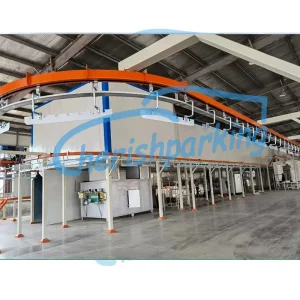
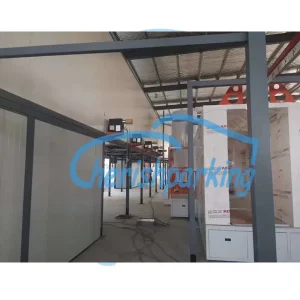
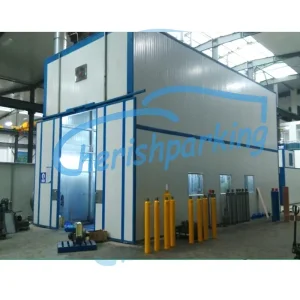
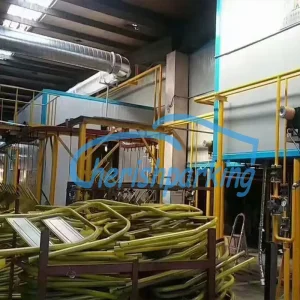
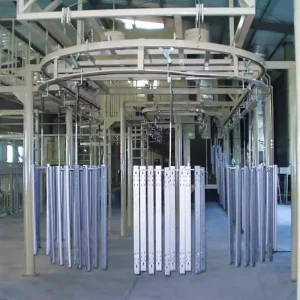
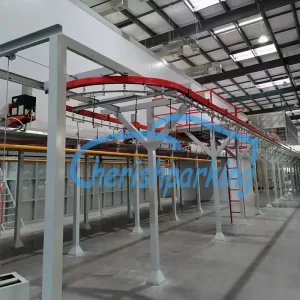
Degreasing 1 → Degreasing 2 → Rinsing → Rinsing → Rinsing → Surface Condition → Film → Rinsing
| Process Sequence |
Operation Mode |
| Hot water rinsing | Spraying |
| Pre-degreasing | Spraying |
| Degreasing | Dipping |
| Rinsing | Dipping |
| Rinsing | Dipping |
| Passivation | Dipping |
| Rinsing | Dipping |
| Pure water rinsing | Dipping |
| Pure water rinsing | Spraying |
| Electrophoresis | Dipping |
| UF1 | Spraying |
| UF2 | Spraying |
| Pure water rinsing | Spraying |
Frequently Asked Questions
What is the primary function of the Dip Tank Pretreatment Line?
The main function is to prepare metal surfaces by removing oils, rust, and other contaminants through a series of chemical baths, ensuring optimal adhesion for the powder coating.
Can the system be customized for specific factory layouts?
Yes, the entire line, including conveyor systems and tank dimensions, can be customized to fit your specific space constraints and production volume requirements.
What industries commonly use this automated coating system?
This system is widely used in the automotive industry, household appliance manufacturing, and any sector requiring high-volume, durable metal finishing.
How does the system ensure a consistent coating finish?
Consistency is achieved through automated conveyor movement and precise timing in each treatment stage, which ensures every part receives the same level of cleaning and coating.
Is the system suitable for parts with complex shapes?
Absolutely. The dipping mode in the pretreatment process ensures that chemicals reach all recessed areas and complex geometries that might be missed by simple spraying.
How does automation impact overall production efficiency?
Automation reduces manual handling, minimizes human error, speeds up the transition between process stages, and allows for continuous 24/7 production cycles.
 Cherish